
Latin Conversation Hour
Location: Stimson Hall, G25
Department Homepage
The College of Arts & Sciences
Our field ranges from great literature, to the basis to western history, thought, legal systems, science and religion, to inscriptions and papyri on individuals and institutions covering all levels of these ancient societies. Through archaeology and art history we investigate and analyze the material record and environment of these civilizations and their neighbors – accessing a past beyond the texts of the elite and their mostly male voices to explore fully this world from top to bottom.
Location: Stimson Hall, G25
Location: Goldwin Smith Hall, G22
Location: Stimson Hall, G25
The Classical world was not just a few wealthy people, their remarkable texts, and some celebrated buildings: classical archaeology, and its integration of techniques ranging across the humanities and the sciences, is how we go behind the scenes to explore the whole human narrative from rich to poor, ruler to slave, with a focus varying from the individual to empires, in order to grasp the full story.
— Sturt Manning, Distinguished Professor of Arts and Sciences in Classical Archaeology
Annetta Alexandridis, classical archaeologist and art historian in Cornell’s College of Arts and Sciences, died April 13. Known for her hands-on approach, she was associate director of the Harvard-Cornell Exploration of Ancient Sardis, Türkiye and co-curated the Cornell Plaster Cast Collection.
Join the Department of Performing and Media Arts and the Department of Classics for Elemental Readings III: The Matter of Earth, a symposium spanning four days and various locations from Thursday, April 23 through Saturday, April 25, and on Friday, May 1. A performance of BIOphelia will take place on Thursday, April 23, from 3:00 pm to 5:00 pm, in Room 121, Cornell Atkinson Center for Sustainability. The Earth Symposium show will take place on Thursday, April 23, from 5:30 pm to 7:30 pm, in the Black Box Theatre, Schwartz Center for the Performing Arts. See below for a complete list of events, including guest speakers, panel discussions, art exhibitions, workshops, and contributor abstracts. Free and open to the public. First-come, first-served.
Cornell admits the Class of 2030 emphasizing real-world impact, enrolling 5,776 students from 102 countries.
At Cornell University, the diverse cohort reflects the land-grant mission and applied learning goals across multiple colleges.
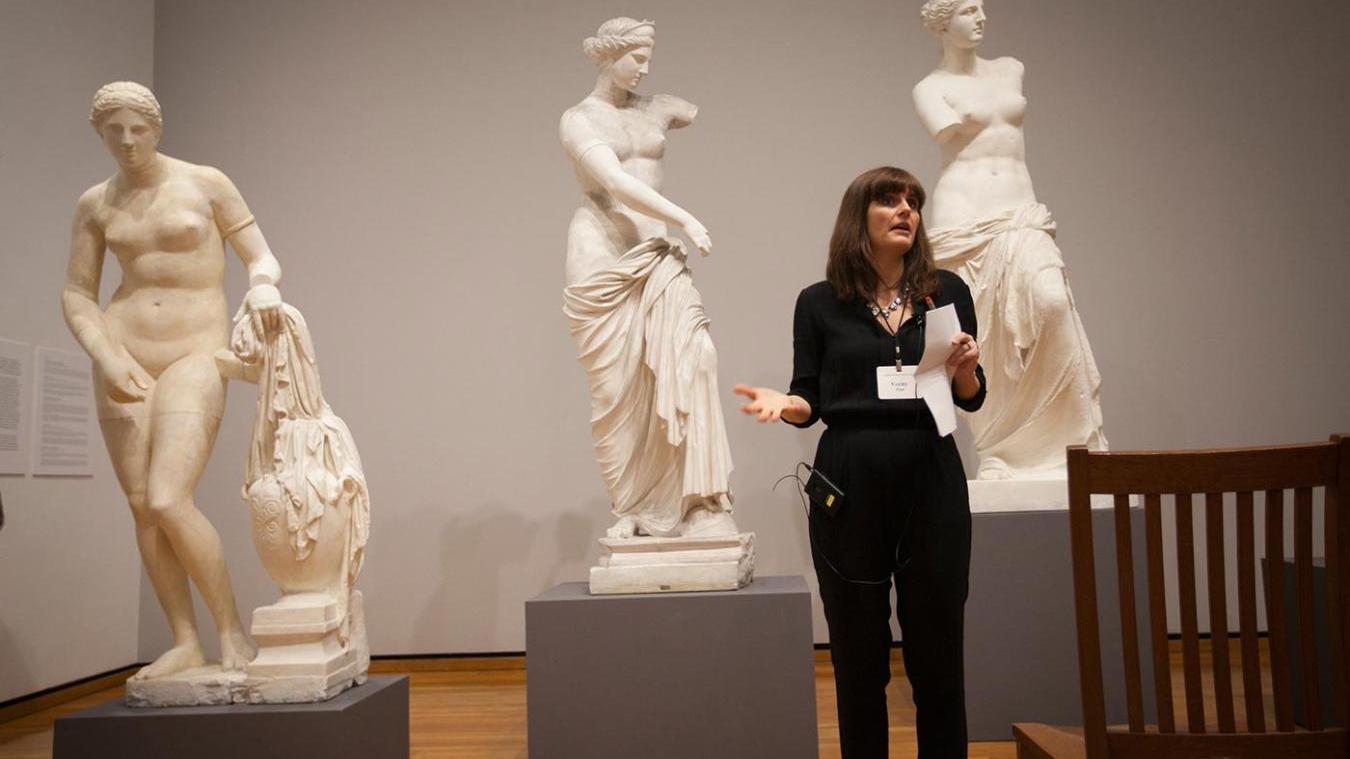
For the ancient Greeks, an image could be understood as a seal pressed on a material to leave a mark, as opposed to an inferior imitation (mimēsis), scholar Verity Platt argues in a new book.
In early February, classics professor Mike Fontaine tapped the expertise he gleaned from writing How to Tell a Joke to address a very modern phenomenon: the current push by many companies for a return to the office.
Based on a 2018 conference co-organized by Caitie Barrett, professor of classics, and Jennifer Carrington, Ph.D. ’19, the book focuses on houses and households during a period when Egypt was ruled by Greeks and then by Romans.
An interdisciplinary team of researchers determined that organic residues of plant oils are poorly preserved in calcareous soils from the Mediterranean, leading decades of archaeologists to likely misidentify olive oil in ceramic artifacts.
A collaboration between Cornell and Harvard has continuously excavated the ancient city.